

community vs capital
a brief history of community-led development in bed-stuy

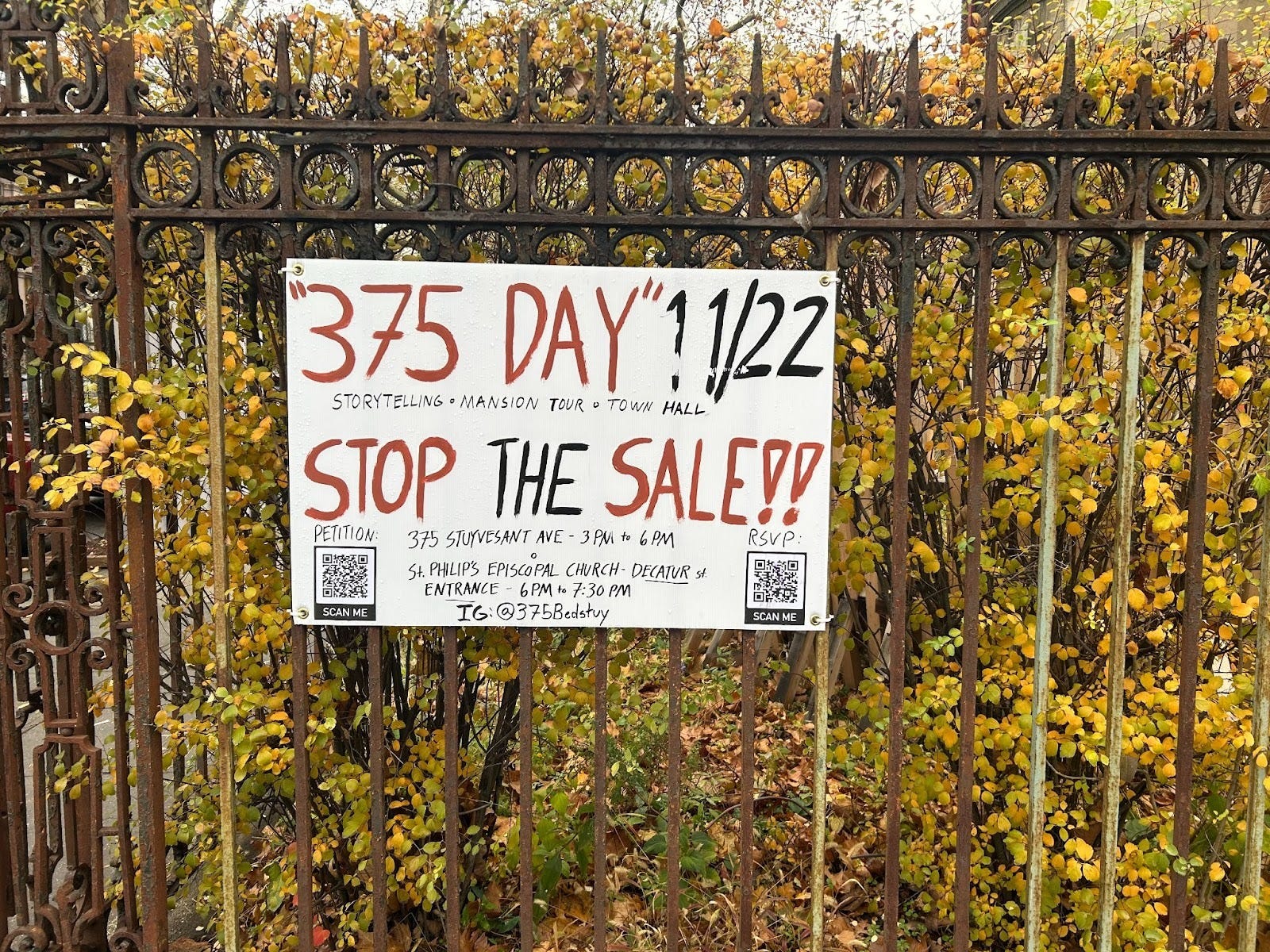
It was a Saturday evening in late November, and a few dozen people had spread out in the sanctuary of a church to discuss how to prevent the sale of 375 Stuyvesant Avenue, a Renaissance Revival mansion in Stuyvesant Heights.
Built in 1915, the mansion was eventually purchased by Dr. Josephine English, New York’s first Black OB/GYN. Dr. English stewarded several buildings throughout Brooklyn, including the former Paul Robeson Theater in Fort Greene. Over the years, 375 Stuyvesant Avenue has served numerous functions, ranging from a senior home and filming location for shows like “Boardwalk Empire,” to its current use as an informal community center, incubating small businesses and serving as a backdrop for celebrations.
However, its future is now in question after a court order clears a path for a prospective buyer to purchase the property. Some of Dr. English’s descendants see an opportunity to cash out, reflecting another dimension of how gentrification can play out, one in which profit - not predatory actions - contributes to the loss of community and cultural spaces.
For the group gathered at the church in November, the sale of 375 Stuyvesant Avenue wasn’t a simple real estate transaction; it was another example of Black history and culture slowly fading away in Bedford-Stuyvesant (Bed-Stuy). At a time when the neighborhood is witnessing an acceleration of gentrification and cultural displacement, the mansion has served as a low-cost gathering space, a physical reminder of the neighborhood’s Black history, and a preview of some of the efforts to imagine a new future.
Contemporary policy discussions about the loss of Black spaces are often situated within a larger narrative about late-stage capitalism, rising housing costs, and the reversal of suburban white flight. Linking the story of gentrification to macroeconomic trends perpetuates a narrative that displacement is inevitable, ignoring the efforts of remaining or incoming community members who are adopting new collective ownership models, like community land trusts, as a way for residents to determine what happens next in their community.
While Harlem has an entire artistic movement named after it, Bedford-Stuyvesant has also played an important role in Black culture and urban policy over the last century.
Brooklyn’s Black population can trace its roots as far back as the colonial era; Dutch Director General Petrus Stuyvesant, whose name still adorns several streets, landmarks, and neighborhoods through New York City, was a prolific slave trader. Shortly after the state outlawed slavery in 1827, a Black middle and upper class emerged, and by the late nineteenth century, some even lived among their white peers. Members of the Black elite class were often doctors, lawyers, and other professionals who served the community.
Black churches and the pastors who led them also exerted political power. Silom Presbyterian Church was established by a former slave in 1849 and would lead some of the first school desegregation campaigns in Brooklyn during the late nineteenth century. Originally located in downtown Brooklyn, the church would follow its congregation in the 1940s to the new center of Brooklyn’s Black community: Bedford-Stuyvesant.
Originally two distinct neighborhoods, Bedford and Stuyvesant Heights were home to some of Brooklyn’s white upper-middle class during the early twentieth century. Many of the architects who were active in Park Slope at the turn of the century were also building lavish homes in this corner of Brooklyn. However, the neighborhoods would eventually become home to the largest Black population in New York City by the 1950s. The construction of the A train in the 1930s made the area more attractive for Black middle-class families who wanted to leave the slums of Harlem in search of better living conditions.
Following World War II, migration from the American South, as well as a new wave of Caribbean immigrants, accelerated the neighborhood’s growth. As the Black population grew, the two names merged, and the boundaries of what was considered Bedford-Stuyvesant continued to expand during the mid-century, eventually including what is now Crown Heights.
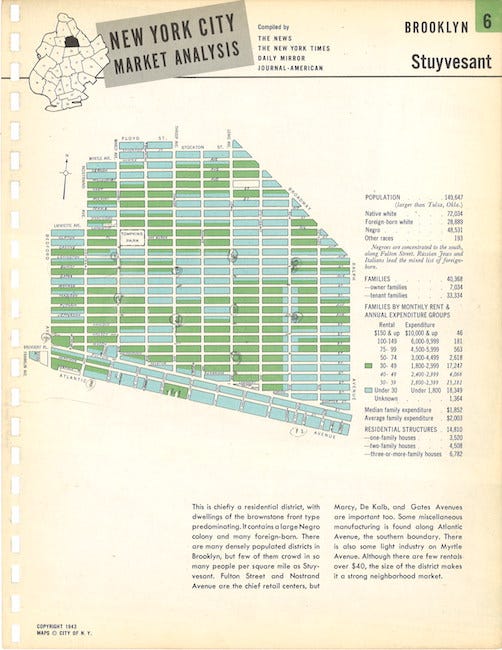
Bed-Stuy became a melting pot of new arrivals and older community members, young Black radicals, and institutional players.
The foundations of grassroots organizing during the Civil Rights movement had their origins in this period of transition. Malcolm X hosted a “Moslem Dinner and Surprise Program” in 1959 at Siloam Church and lived in the neighborhood for a period of time; Dr. English delivered Malcolm’s children, furthering the contemporary activist group’s claim of the mansion’s cultural and historical significance. In the early 1960s, Brooklyn’s chapter of the Congress of Racial Equity staged a local demonstration against discriminatory trash collection practices, gathering litter left by the Sanitation Department on Gates Avenue and dumping it at Brooklyn Borough Hall. Shirley Chislom, who would become the first Black female congresswoman in 1968, got her political start in organizations focused on neighborhood revitalization and youth programming.
During the mid-twentieth century, one of the biggest sources of national anxiety was youth delinquency. America’s young men were in a crisis - best captured culturally through films like “Rebel without a Cause” or, later, “West Side Story” - and concerned community members, like Chislom, were volunteering in groups to help them. Programs from this period initially focused on wayward teens but soon began to consider the “root causes” of poverty, like having a parent out of work. Dozens of organizations were created in Bed-Stuy to address community challenges, including improving access to jobs and upgrading the aging housing stock.
At the time, Bed-Stuy had some of the largest Black homeownership rates in the country. One of the first community groups, the Bedford-Stuyvesant Neighborhood Council, was created in 1939 and represented block associations. Oftentimes, the goal of these smaller community initiatives was to protect and preserve access to homeownership. One early initiative that invested in both the economic future of young men and property upkeep was a program where homeowners would pay local neighborhood boys to rehabilitate historic brownstones at a heavily subsidized rate.
Given that most community organizing was focused on homeownership, wealthier, more educated Black residents tended to dominate the public conversation, though their programs weren’t always as self-serving as low-cost home repair. In line with earlier iterations of ‘lifting while climbing’ - in which upwardly mobile Black Americans viewed it as their duty to support the educational, economic, and political advancement of the entire race - the Central Brooklyn Coordinating Council (CBCC) was formed as a “cultural development project that [would] expose the deprived child to middle-class values.”
At its peak, CBCC represented a coalition of nearly 100 organizations and was arguably the center for Black political influence. Chisholm and other rising political stars, like Elsie Richardson, who became the public face of CBCC during local meetings and visits with elected officials, were active members. Several of the most beloved community programs from the midcentury were affiliated with the CBCC, including Youth in Action (YIA)’s Young Mothers Program, which provided in-house nursing and other supportive services for teen mothers to finish their high school education. However, CBCC also lacked representation from the working class. Every one of YIA’s twenty board seats was held by a college graduate.
As the nation entered the turbulence of the 1960s - increased protests against racial discrimination, political violence, anti-Vietnam War demonstrations, women stepping into more publicly visible roles - these issues would reveal a growing power struggles over who would define Bed-Stuy’s next chapter.
By the mid-sixties, white elected leaders began to pay closer attention to New York, hoping to avoid another Watts. As a first-term U.S. Senator eyeing a presidential bid, Robert F. Kennedy had all the more reason to make sure Bed-Stuy didn’t become a national embarrassment. He began meeting with community organizers, planners, and residents in early 1966 to hear their concerns. Political commentators at the time referred to this - and other similar policies - as “riot insurance.”
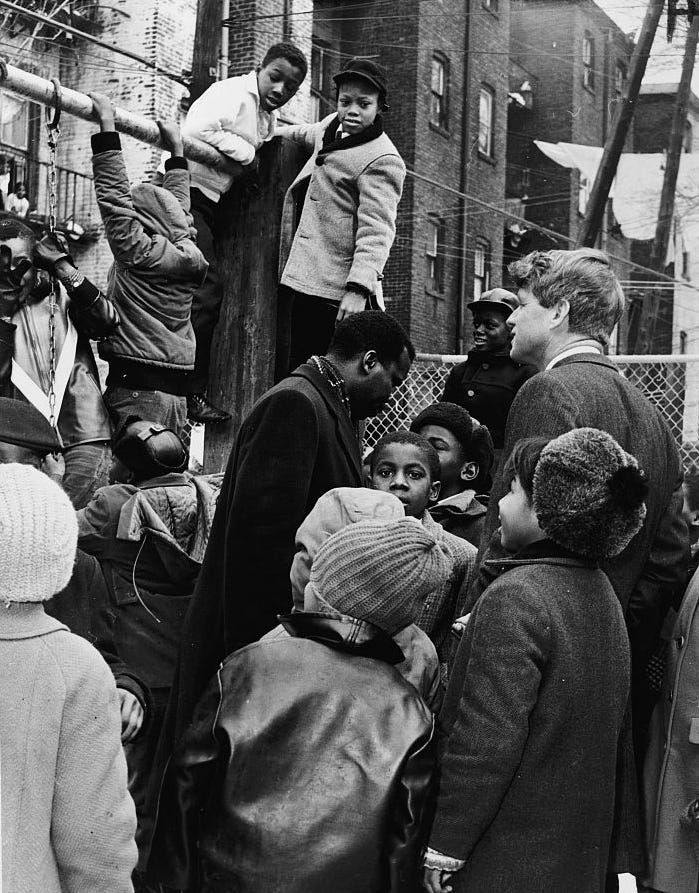
On December 10, 1966, Kennedy announced the creation of the country’s first community development corporation that would “combine the best of community action with the best of the private enterprise system.” In addition to federal funds, Kennedy solicited some of the biggest names in business and philanthropy, including the Ford Foundation, IBM, and CBS.
By the late 1970s, federal and local funds that had once supported programs like YIA had all but vanished. Bed-Stuy Restoration Development, located on 1358 Fulton Street, became the only game in town. Restoration’s dominance was largely thanks to its white, wealthy donors, who were more willing to funnel resources toward an organization they had direct oversight over, versus smaller groups that were often run by women and had ideas that existed outside of the mainstream.
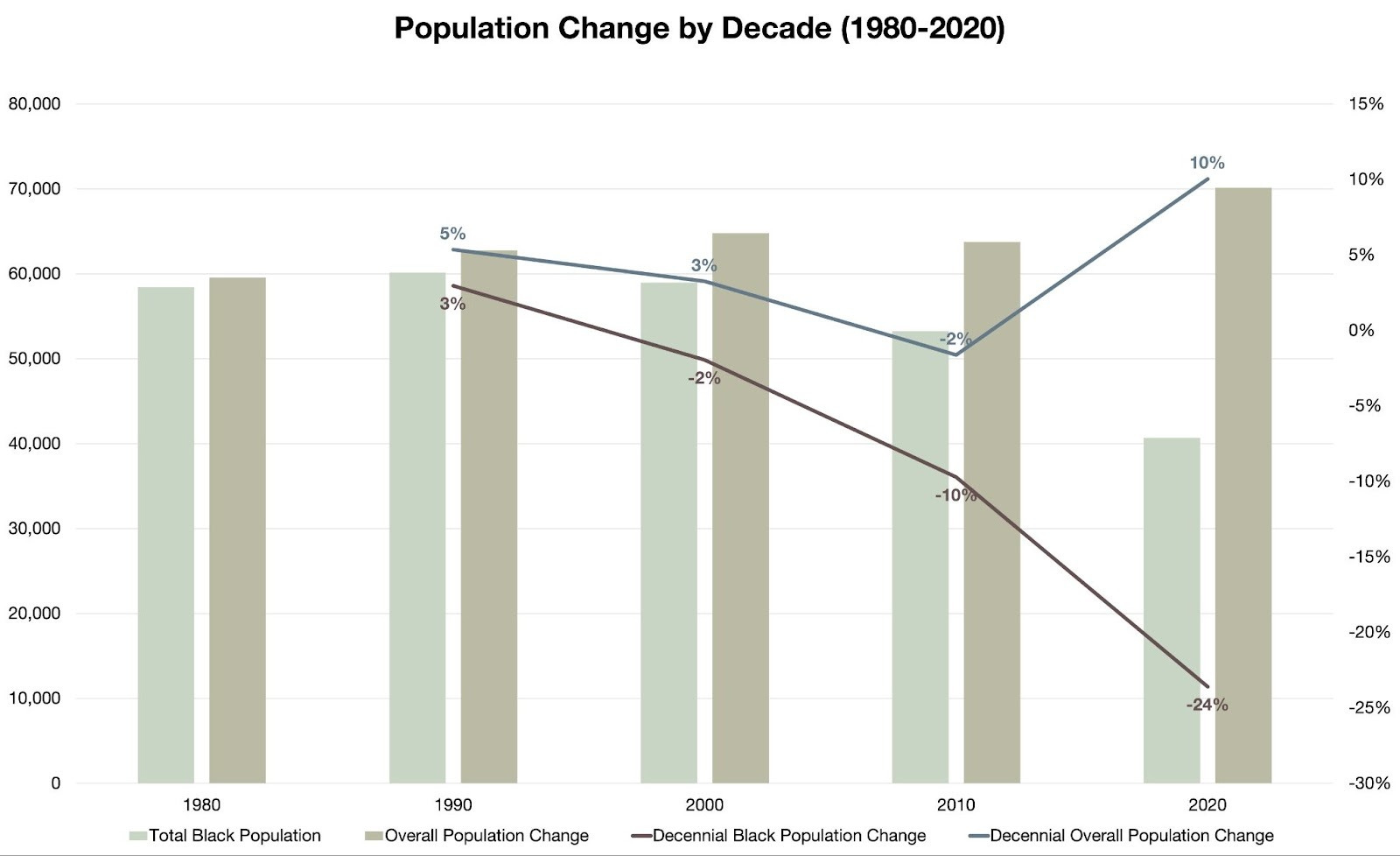
Reaffirming Black class dynamics in a post-Civil Rights context meant physical separation. Once legislation like the Fair Housing Act made it easier for the Black middle class to move to the suburbs, cities across the country with large Black communities saw a rapid population decline. Black elites also began to reframe the more radical language and policy goals of the sixties, instead focusing more explicitly on maintaining their own upward economic mobility. This meant Restoration’s programs were primarily targeted to stop the outflow of the Black middle class, not create programs that would support and uplift the growing low-income population. As such, Bed-Stuy Restoration’s signature programs were homebuying assistance and repairs.
Census data and anecdotal comments from long-time neighbors support Restoration’s initial success. Some census tracts in the neighborhood saw huge spikes in household income between the 1980 and 1990 censuses while remaining almost entirely Black. However, the desire to achieve upward social mobility often meant this group distanced themselves from the ‘wrong’ type of Black American. There was now a stronger political distinction between newly hired, corporate middle management and poorer or more radical factions of the Black community that wanted to overturn capitalism to address structural economic inequality.
The result is a type of neighborhood development that focused on individual problems - a “pull yourself up by your bootstraps” mentality - rather than the expansive approach of community-oriented solutions. For the next several decades, organizations like Bed-Stuy Restoration focused on helping people attain a mortgage but didn’t consider the long-term vision for the neighborhood.
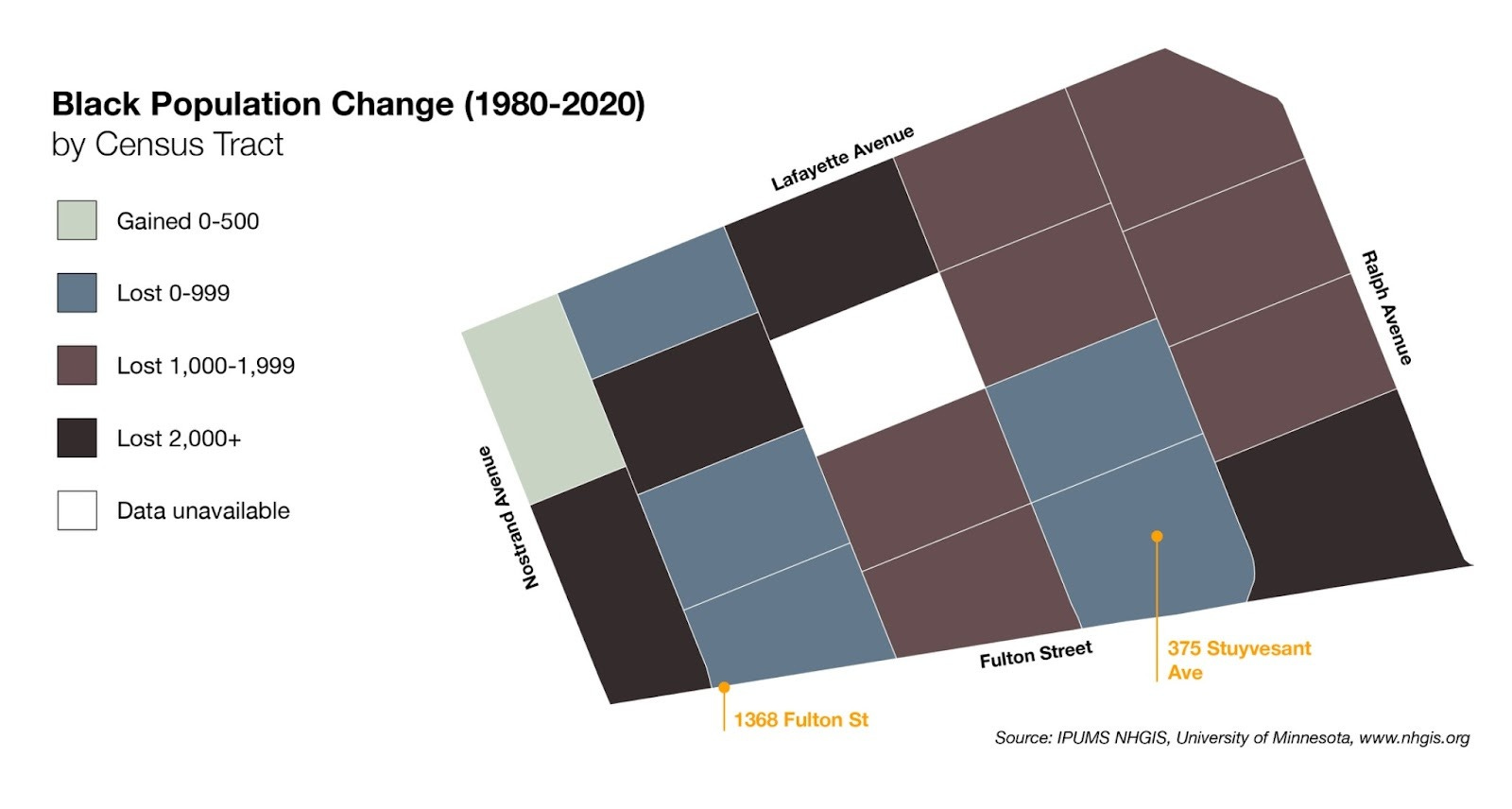
Grassroots organizers, like Jitu Weusi, warned about what would happen by prioritizing home repair over other initiatives - questioning who Bed-Stuy Restoration was preserving the brownstones for: the Black community or an eventual return of the white upper-middle class? These were valid concerns at the time, given the new wave of white homebuyers returning to Cobble Hill and Park Slope in the 1970s and 1980s. Fifty years later, those fears are now actualized in Bed-Stuy.
Since the 2010s, Bed-Stuy’s Black population has declined at such a rate that the neighborhood is now barely majority Black. Some of this loss is attributable to predatory actions, like deed theft, or rising property taxes. However, several Realtors active in the area also talked about how family members see gentrification as their golden ticket. The reality is that homeownership is still the primary way Americans achieve and pass down generational wealth. Many of the homebuying programs that made it possible for the Black middle class to purchase in the midcentury have now provided an opportunity to cash out at the expense of leaving Black cultural history to the whims and mercy of the highest bidder.
While the neighborhood has lost a substantial share of its Black population, remaining residents and newcomers alike are working not only to preserve its cultural legacy but also to create something that is distinctly of the twenty-first century.
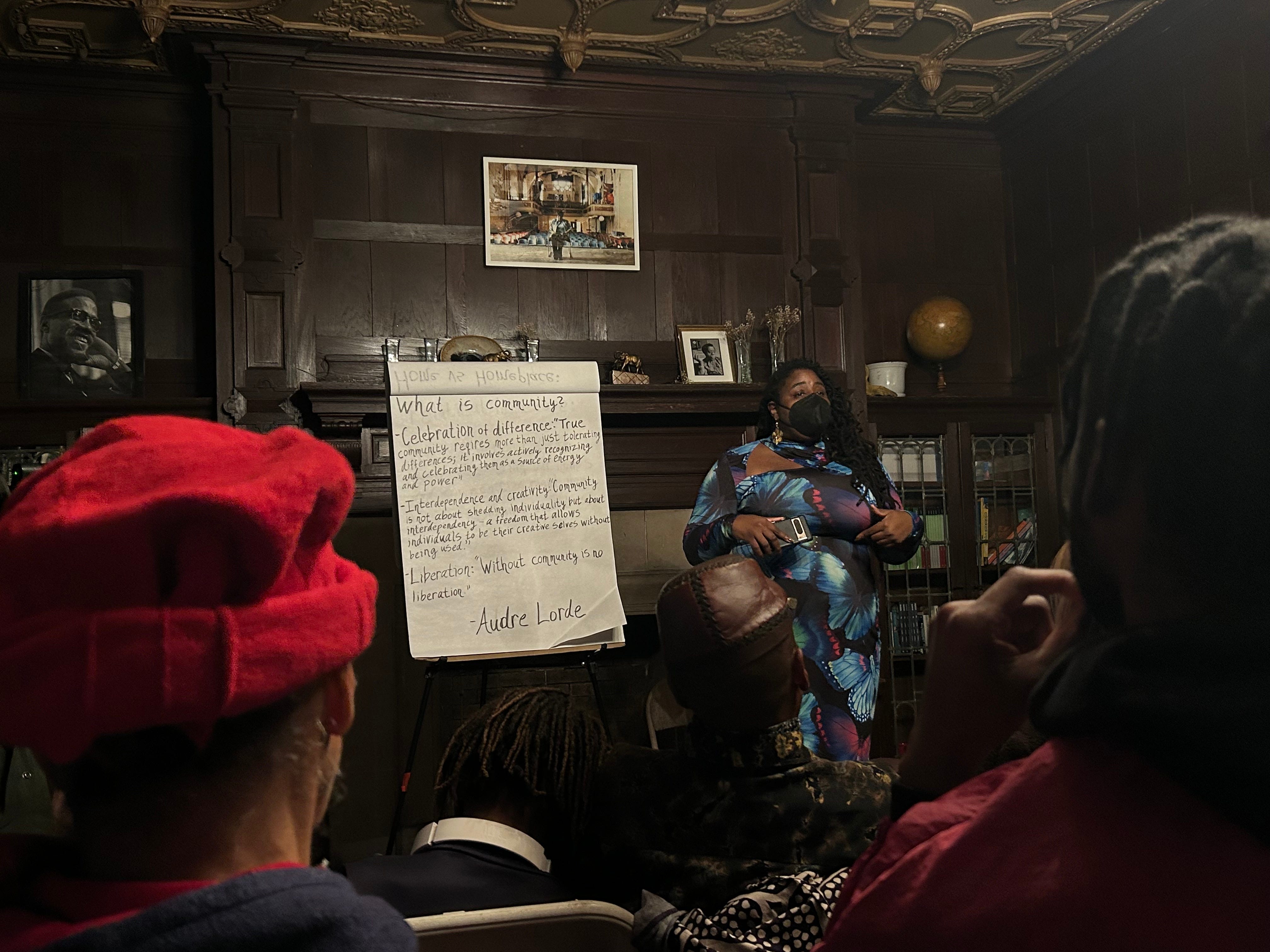
Once it became clear that the family controlling 375 Stuyvesant Avenue was moving forward with selling, different organizations currently housed at the mansion started mobilizing. In late November, local organizers hosted a community action day. Much like the community groups that began 60 years ago, the leaders that night were overwhelmingly Black women representing a spectrum of ages, backgrounds, and connection to the building. Some had lived in Bed-Stuy their entire lives, witnessing everything from Chisholm’s political rise to the ‘do or die’ days and the neighborhood’s more recent changes. Others were newly arrived, drawn to the promise of stoops and block parties. Following an afternoon featuring storytelling, connection, and a tour of the mansion, the group held an initial organizing session nearby at St. Phillip’s Church to brainstorm how to keep the building in community control.
One of the proposed solutions is to acquire the property and incorporate it into the BLAC Land Trust. A community land trust takes land off the speculative market and allows an organization to collectively steward it by leasing the land; when someone purchases a home in a land trust, they agree to sell in the future at an affordable, set rate. Similar models exist for community assets. One of the first land trusts in the country stewards property in and around Cooper Union in Lower Manhattan.
GrowHouse, a local design and development group, established the land trust a few years ago to protect Black cultural assets. BLAC Land Trust is currently raising capital and acquiring funds to purchase the mansion as the first project in their portfolio. During the meeting in November, Shanna Sabio, GrowHouse’s co-founder and co-director, emphasized the benefits of collective ownership and a way to honor Dr. English’s legacy by preserving a beloved community resource.
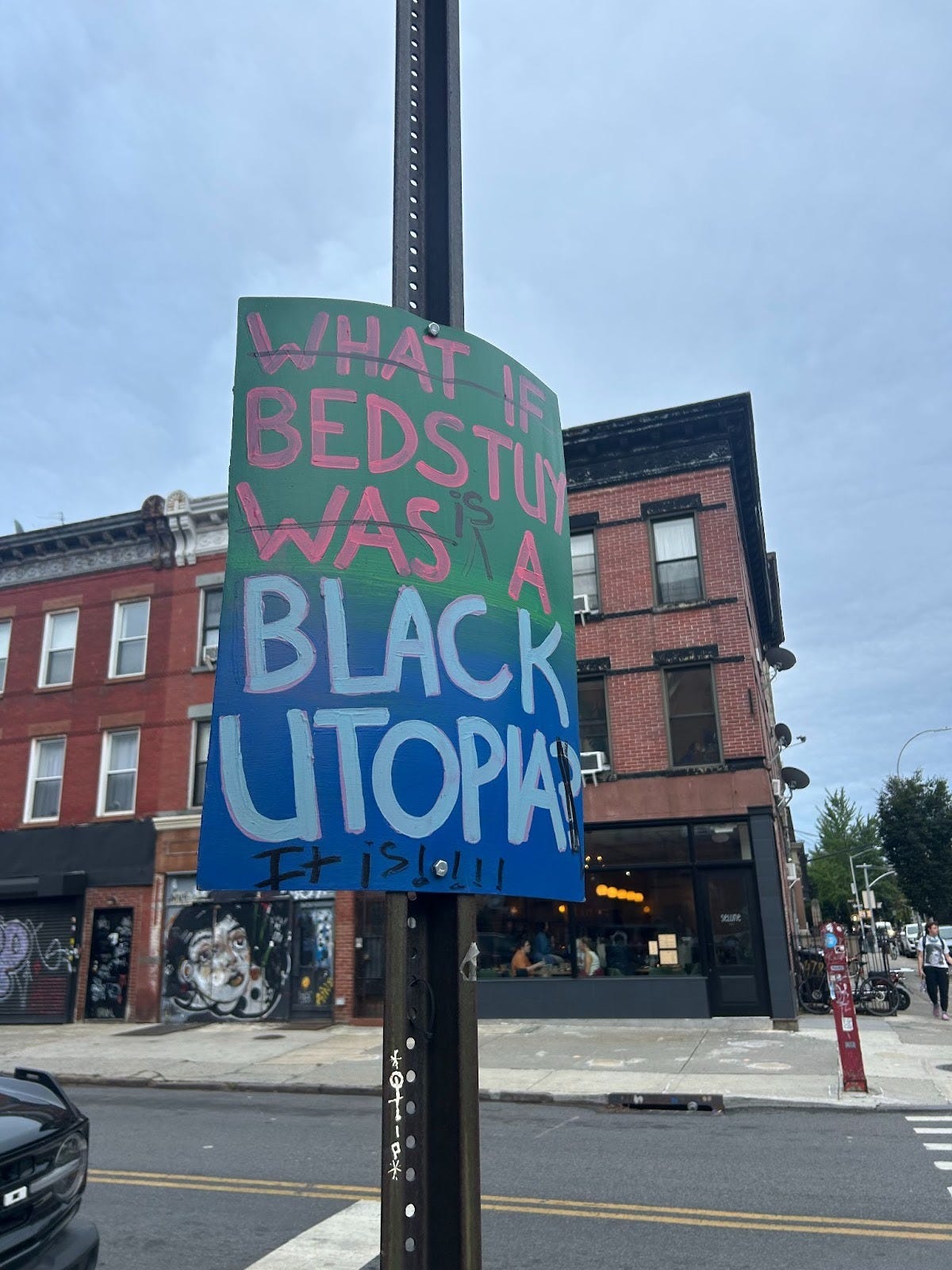
While the fate of the property is still in limbo, the recent advocacy and organizing efforts show that a new generation of Bed-Stuy residents is willing to fight for their community. People are realizing, once again, that there is also value in community over profits. The question now becomes, who will get to have a say in the neighborhood’s future this time around?
A version of this story will appear in the print version of Public Bonds Magazine later this spring.