

"covered holes in our walls with sunflowers"
reflections on jordan casteel's casey kaplan exhibit

Some of the most powerful art captures an individual’s unique perspective while speaking to a universal experience.
This is true across mediums, whether that is the circular joy of Maurice Ravel’s “Bolero” or the laser-focused satire of Obama-era Brooklyn millennials through “Search Party.”
Visual media in particular has this ability to document a specific time and place, forever crystallizing a singular moment - real or imagined - that generations can return to decades or even centuries later, and why I believe we will see even more of a premium on physical media in the coming years. There are entire sub-communities online dedicated to lost media, content created decades or even a few years ago that is now no longer accessible on streaming platforms or websites. Even for content that is still currently accessible, there is a sense of impermanence, as distribution rights to media mean certain shows frequently shift from platform to platform.
Physical media and archival records are also the main way our society tracks history, ignoring the storytelling and oral history practices found throughout non-Western cultures. Yet pointing to a lack of a physical record is another form of erasure, one that minimizes the humanity of oppressed groups, as if creativity was not present on the ships of the Middle Passage or while toiling in the heat on sugar and cotton plantations.
Over the holidays, I went to the newly reopened Studio Museum in Harlem. Originally conceived as a “place where Black art lives,” the museum first opened in 1968. Throughout its nearly sixty years, the Studio Museum in Harlem has played an important role in incubating, promoting, and preserving the works of the African diaspora. An archival exhibit on the sixth floor begins to capture its influence and impact, but the long-running artist-in-residence program is perhaps the best way to understand the museum’s impact on modern art.
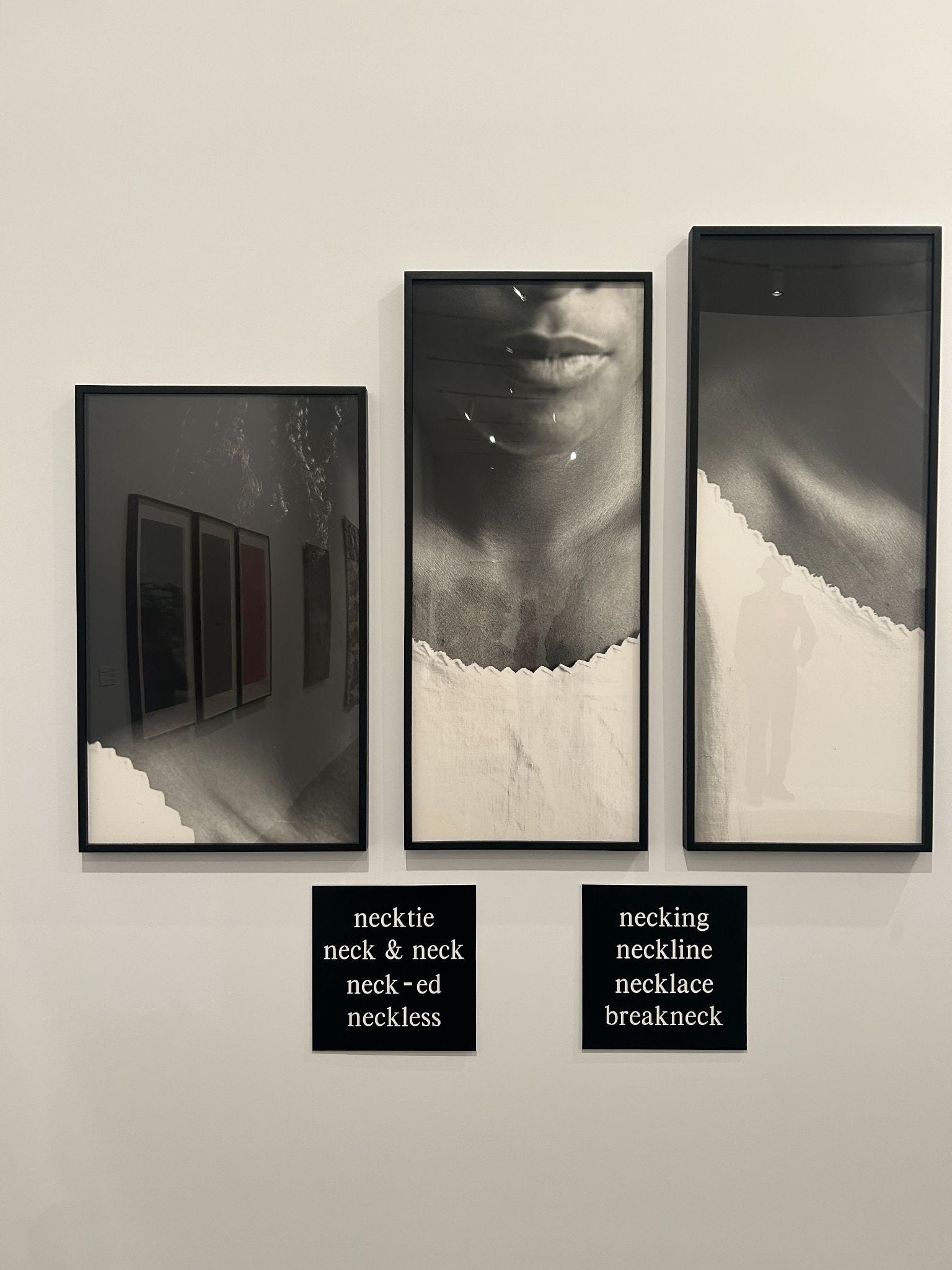
The list of alumni on the fourth floor exhibit reads like a who’s-who of Black artists over the last five decades, ranging from David Hammons, whose flag adorns the entrance of the museum, to Renee Green, who has a year-plus-long exhibit still on view at Dia Beacon. But perhaps the most notable recent graduate over the last decade is painter Jordan Casteel.
Long before walking the red carpet of the Met Gala, Casteel first broke out into the mainstream art world in 2014 through her ‘Visible Man’ series.
This was the summer of Eric Garner and Michael Brown; in the fall, 12-year-old Tamir Rice would become another victim of racial violence. At a time when images of Black men in the media were often moments before their death, Casteel’s ‘loving, intimate, caring’ portraits of Black men presented a welcome counternarrative.
Her latest body of work, which closed last weekend at the Casey Kaplan Gallery, continues this exploration of Black domesticity. This show brought together some of Casteel’s previous experiences - a nod to the Studio Museum; portraits that emphasize softer moments of Black life; landscapes and floral motifs - while also serving as a deeply personal meditation on her desire to become a mother.
The exhibition’s name, “covered holes in our walls with sunflowers,” takes its name from an Alice Walker essay. Published in 1972, at a time when Black art was receiving more mainstream recognition, “In Search of Our Mothers’ Gardens,” Walker writes about how generations of Black women yearned to turn their soul’s purpose into art but never could, instead planting seeds they would never see bloom. It is only relatively recently that Black Americans, but especially Black women, have begun to enter the recognized American canon. By choosing a line from this essay, Casteel chooses to situate herself on this continuum of progress and recognition.
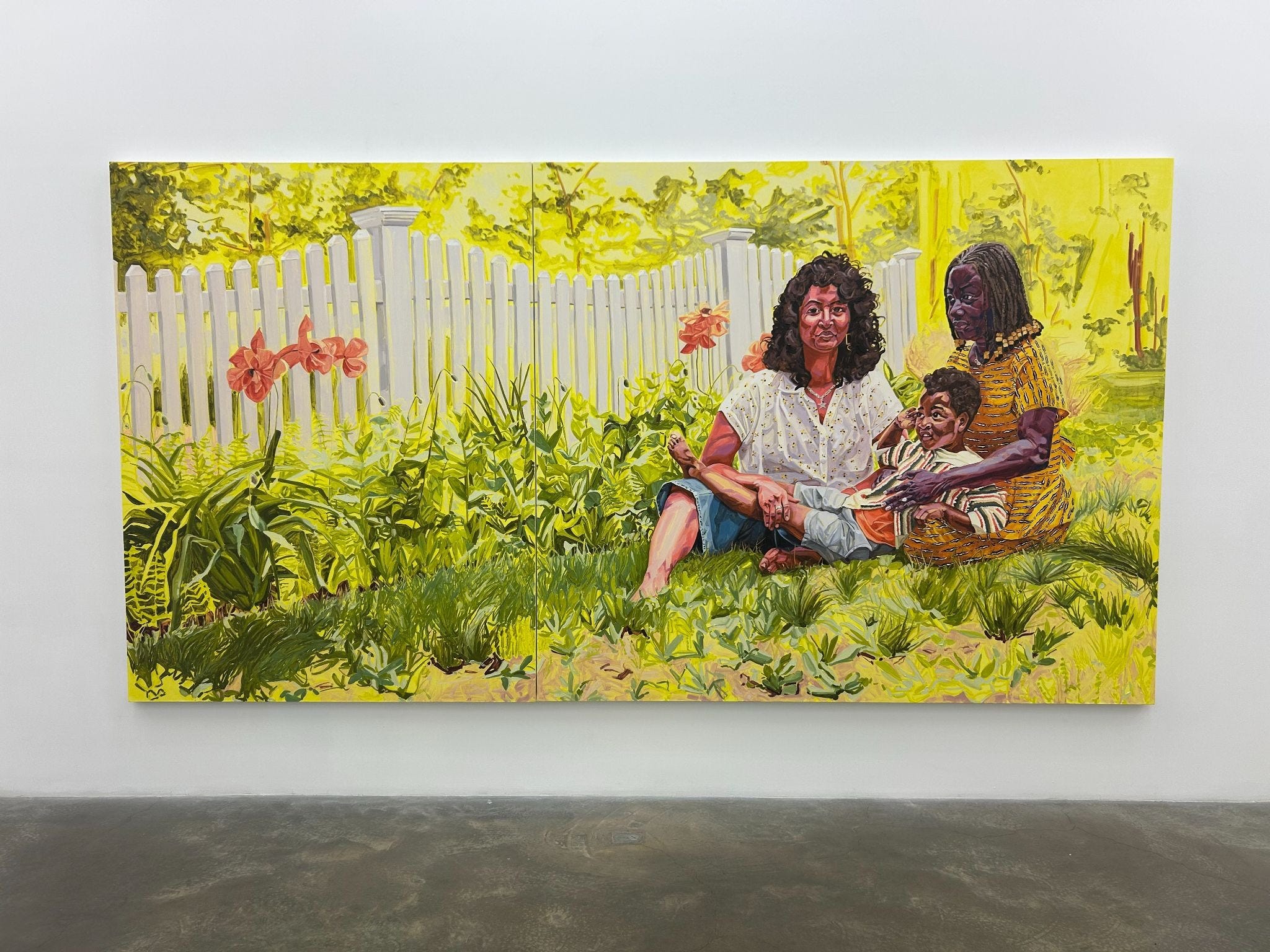
The most obvious nods to Walker’s commentary are several tightly cropped plein air representations of flowers and a vibrant, monumental portrait - Casteel’s largest to date - of two mothers and their child at rest in the grass.
The women represent a modern type of family by creating two points of protection as they embrace their child, forming a triangular unit. Spread across two canvases, two groups of flowers in the background mimic this trio while the rest of the garden - all of those other planted seeds and long-held dreams - wait to burst forth. They are both dressed in various combinations of black, brown, and yellow, evoking both those great pollinators - as is the case of the woman wearing a casual button-down adorned with bees, confidently gazing at us - but the braided woman’s dress also calls to mind the color palette of sunflowers.
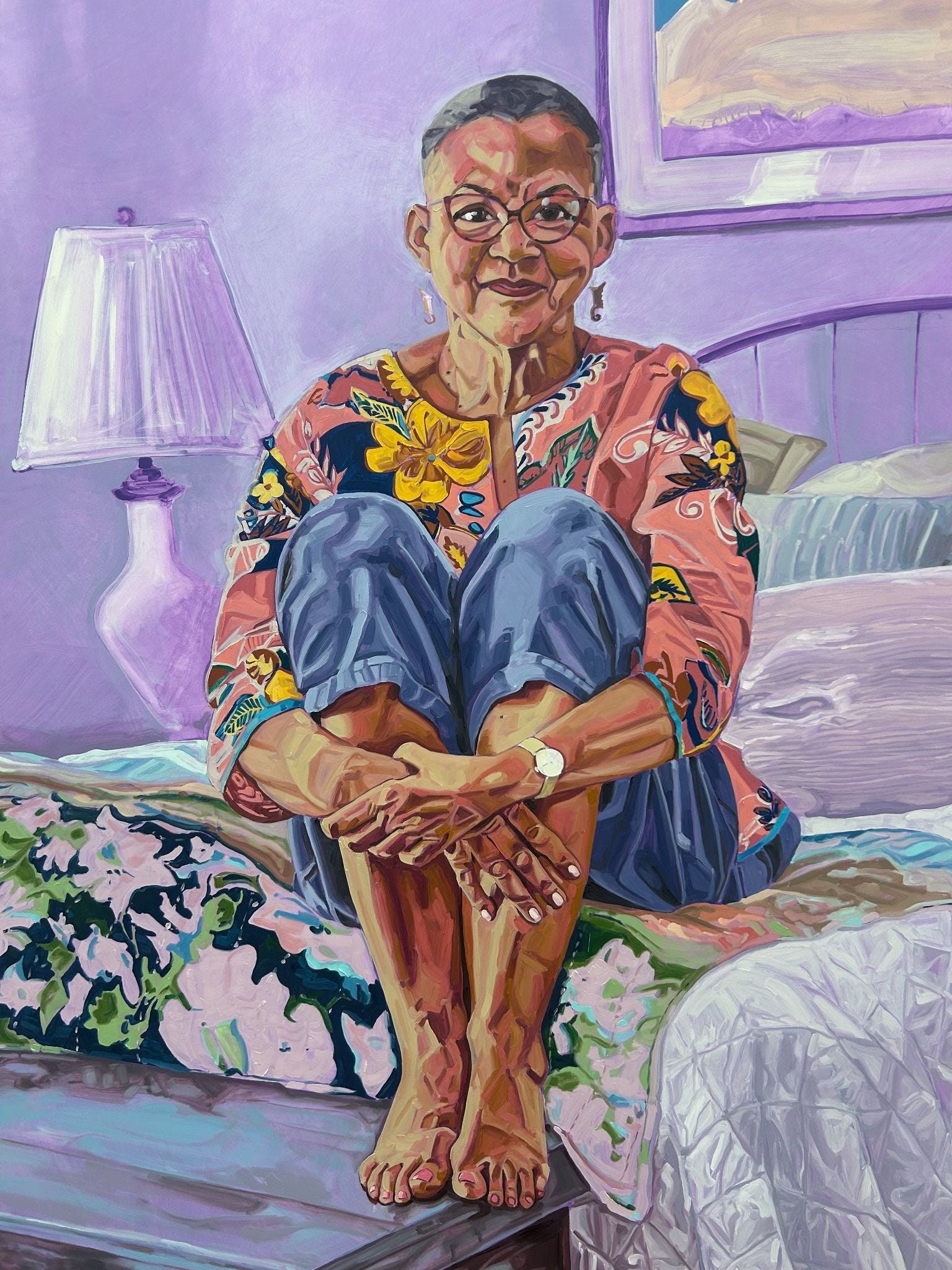
Another painting, “Mothering While Black,” could also serve as a subtitle for the exhibit. A flower curves over the book as it rests face up on a desk, its color arc acting almost like an umbrella, providing a protective cover. This piece sat diagonal from a portrait of Casteel’s own mother, a woman she portrays with an almost girlish sensibility through her pose, not unlike a kindergartner sitting on a carpet - or in this case, a colorful comforter - patiently awaiting instruction. There is such love in this gaze and a certain level of vulnerability, a temporary inversion of power dynamics, where the parent now becomes the sitter, awaiting instruction and guidance from the artist. Casteel typically paints from photographs, and I’d like to imagine they were chatting and laughing in her mother’s room, that she captured this moment right as she looks up in pride at her daughter.
But perhaps the most intimate of the paintings on view was Casteel’s self-portrait, which is where the themes of the exhibit merge into a coherent thesis.
The self-portrait is an intimate window into Casteel’s fertility journey and how capturing the world around her serves as a quiet balm during an otherwise draining period. In the painting, Casteel is surrounded by plants in various states of maturity. Some are little seedlings on trays, while others are potted; in the background, an entire forest seems to emerge.
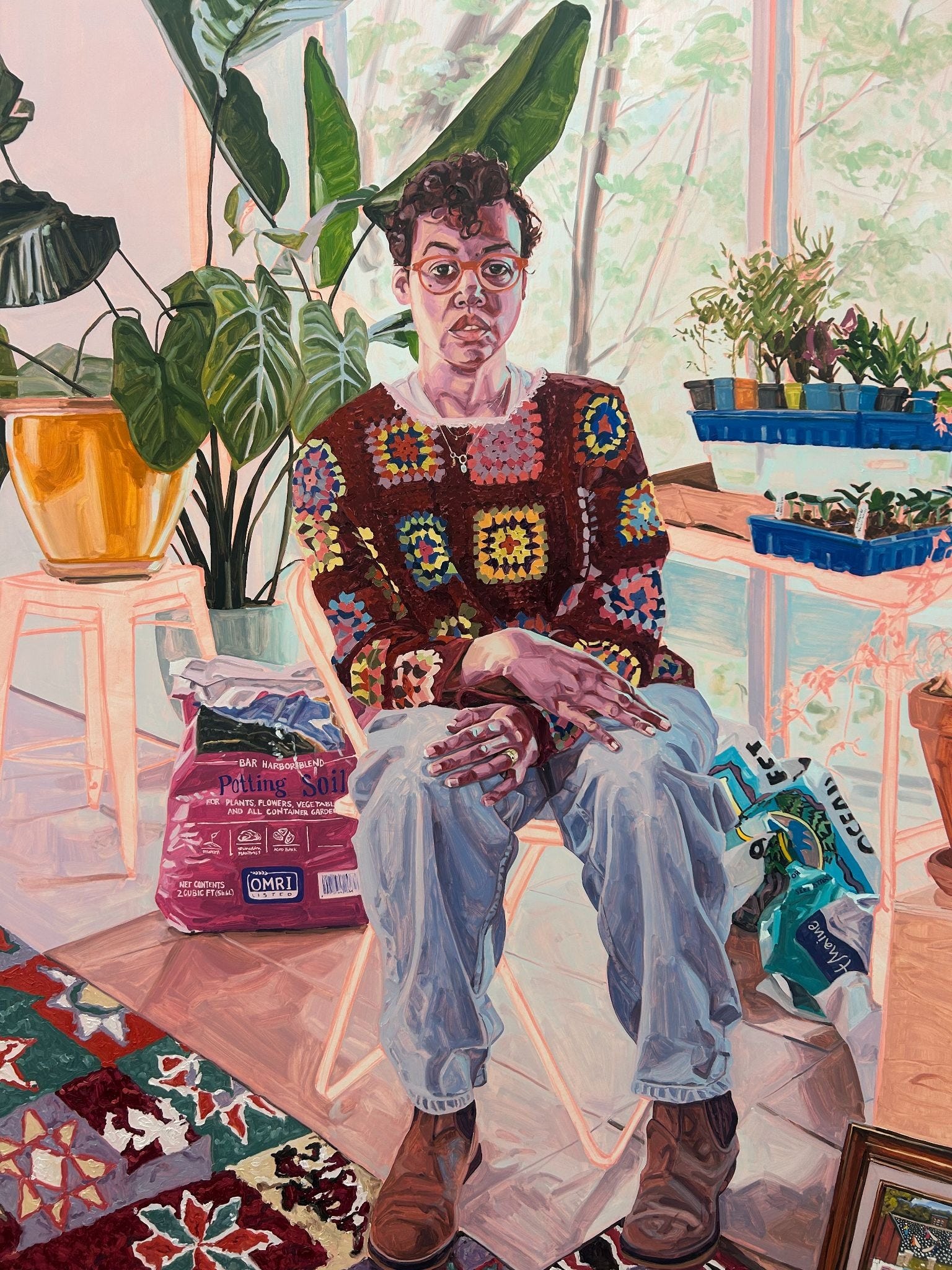
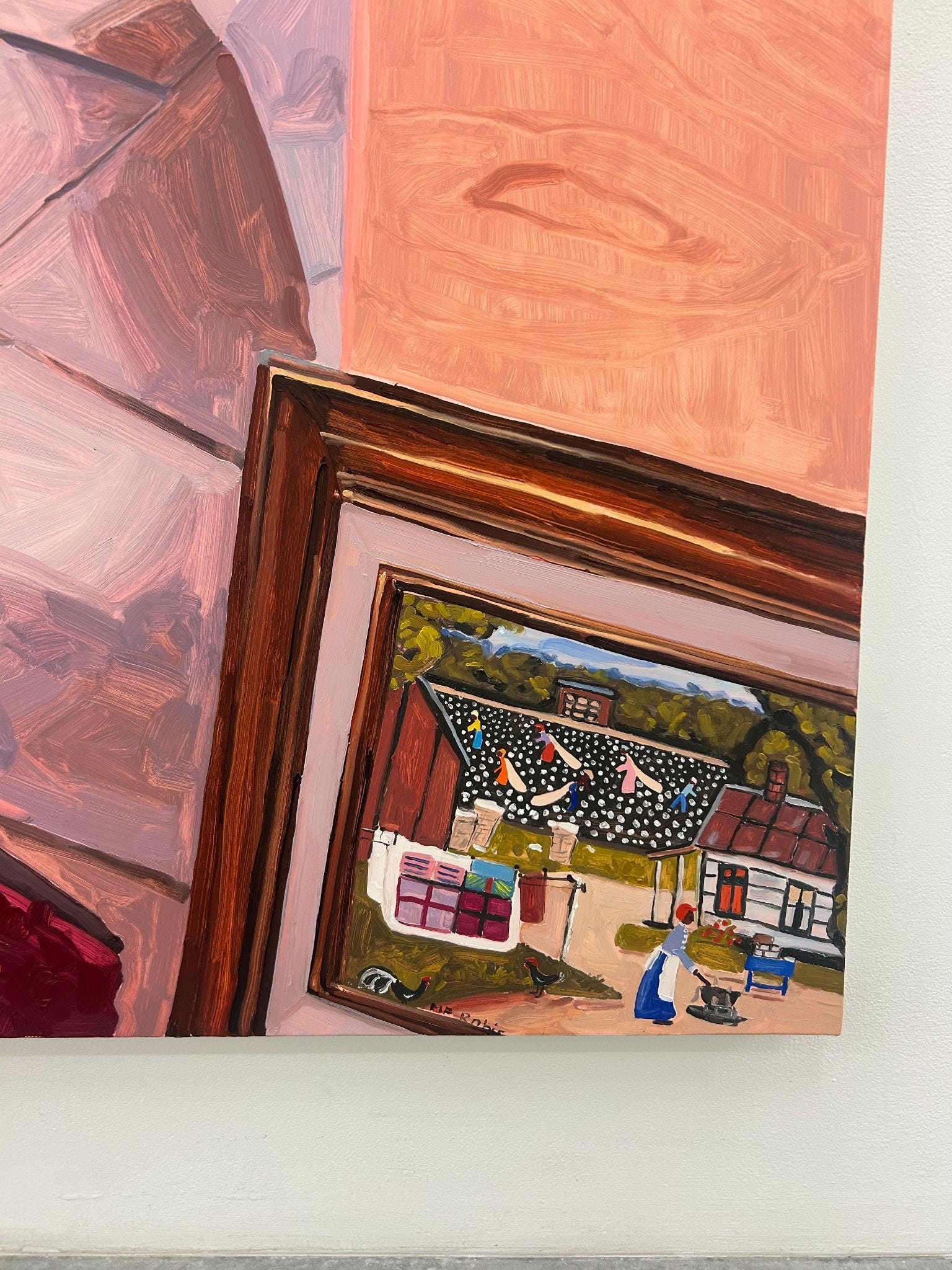
In the essay, Walker talks about how a quilt made by “an anonymous Black woman in Alabama, a hundred years ago” is now part of our country’s formal record (for now), memorialized at the Smithsonian Institute. Quilting spans across race and culture, serving a dual purpose as practical objects that warmed bodies and an opportunity for its makers to imbue special meanings. Casteel’s sweater and the rug each featured quilted designs.
What’s less noticeable until further inspection is their nod to the small painting in the lower right corner, which shows slaves working a cotton field. In the foreground, Casteel features a lone washerwoman next to quilts on the line, drawing a connection from the past into the present. It is in this way that Casteel both inserts herself as an artist - she will not be anonymous - while also acknowledging the work of this woman lost to time.
However, it was only after I had left the exhibit and was starting to research this essay that the self-portrait became even more meaningful. Days before the show’s opening, Casteel revealed through an Instagram post that the painting was originally conceived as a mother-child portrait. Casteel and her husband have tried to conceive for over five years. The caption includes quantifiable points that finally led to them hearing the heartbeat for the first time, the day she completed the self-portrait. With this additional layer, the show clicked into place for me.
Last year, I saw an exhibit, Really Free, at the California African American Museum. The artist, Nellie Mae Rowe, was born around the same time as Walker’s mother, at the turn of the twentieth century. And much like Walker’s mother, Rowe had her own dreams of becoming an artist. However, that wasn’t the type of life made available to a Black woman in rural Georgia. Instead, Rowe painted casually for decades, outliving two husbands and the family she worked for as a domestic. It wasn’t until the last fifteen or so years of her life, in her mid-sixties, that Rowe was finally able to achieve her soul’s purpose. And who knows how many other Nellie Mae Rowes were out there, generations of artists lost to time.
Many of us today are the living embodiment of our ancestors’ wildest dreams. This isn’t to say modern life isn’t without its faults - we now live in a post-Roe world - but artists like Walker and Casteel know that amidst the pain, against all the emotional wounds, each of us still has the opportunity to fill that sorrow with joy whenever we can, wherever we can.