

going for it: tiffany dockery + gladys books and wine
a frank conversation about capitalism, sexuality, and what it takes to run a bookstore in brooklyn.

Welcome to Going for It, an interview series that uplifts and celebrates the big, bold moves people are taking to actualize their dreams. Each month, I’m sharing the stories of people who are trying, failing, and growing as they work to turn their idea into a reality.
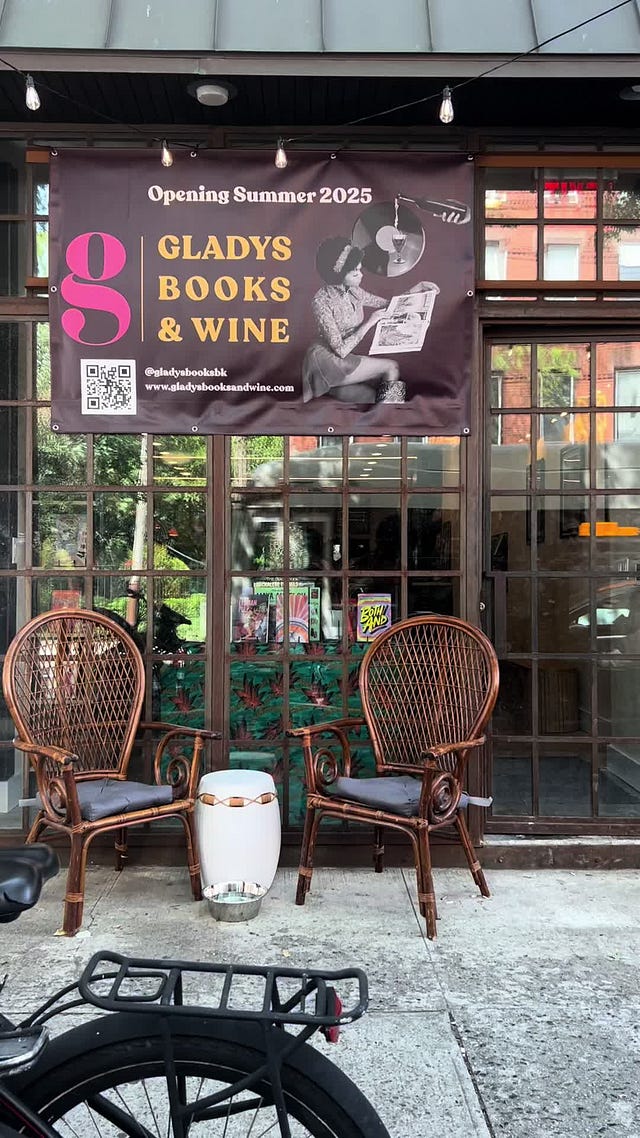
This month, I’d like to introduce you to Tiffany Dockery, the owner of one of Brooklyn’s newest Black-owned bookstores: Gladys Books and Wine. Located in Bedford-Stuyvesant off of Malcolm X Boulevard, Gladys sells a variety of titles and has a specific focus on uplifting the Black lesbian community.
In addition to owning and operating a bookstore, Tiffany also works full-time in tech. Despite the level of privilege that comes with working a six-figure job, there are still systemic barriers that make brick-and-mortar entrepreneurship nearly impossible for those who don’t have easy access to capital or generational wealth. Tiffany has gotten creative with her funding to open Gladys, including dipping into her retirement savings (known as a Rollover as Business Startup), using a home as collateral, and even turning to her community in a pinch.
Opening Gladys has required a lot of blood, sweat, and tears - and approximately a quarter of a million dollars, the cost of which shows in how beautifully designed the space is. With its emerald green and gold accents, Gladys has a cozy, neighborhood vibe that feels pulled out of another era. A bell tinkles each time the door opens and someone is almost always at the coffee bar to give a big hello. Visitors can curl up on a couch upstairs, which is the main bookstore and coffee shop, or have a more intimate, moody experience downstairs at the wine bar.
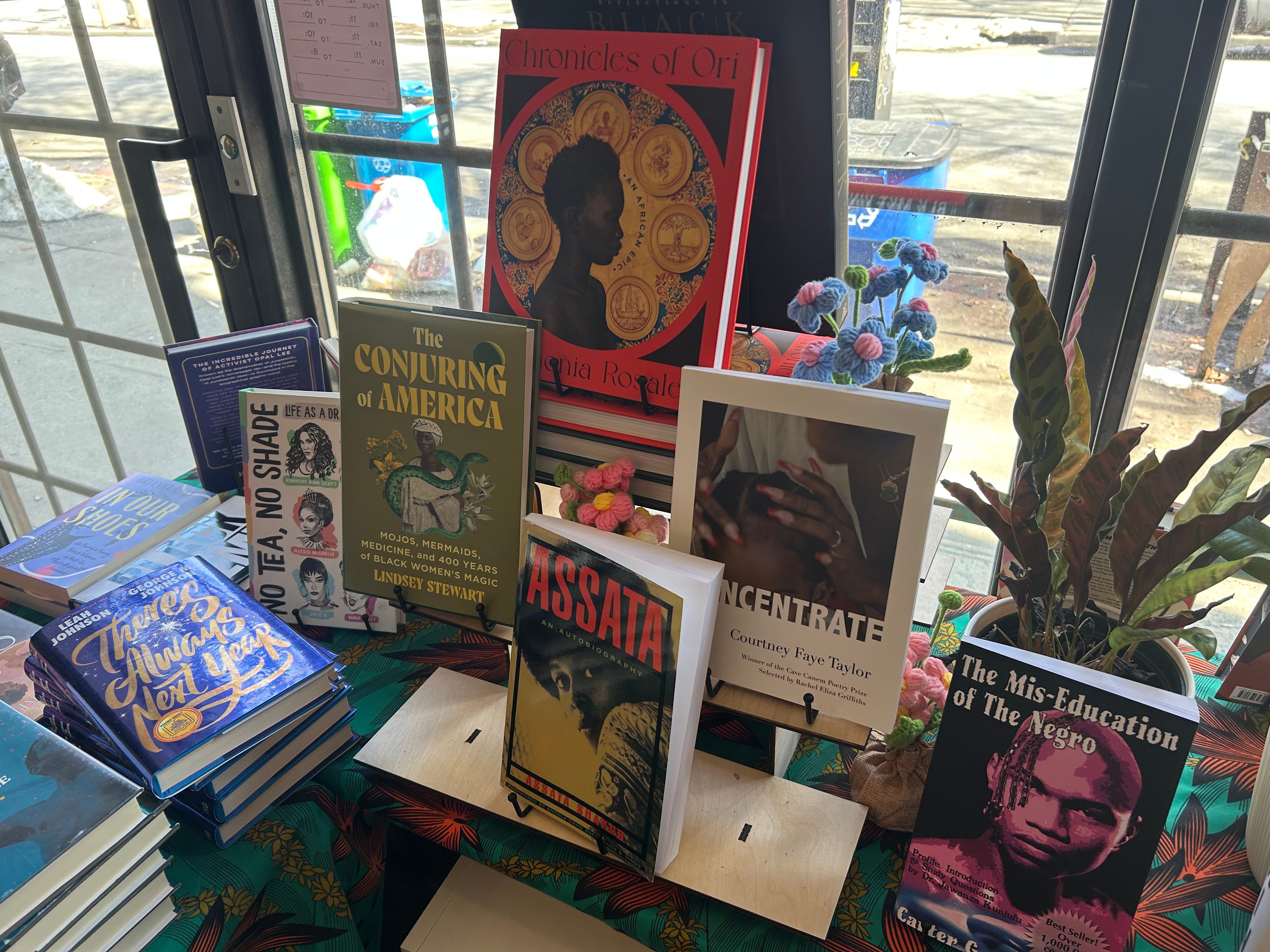
Last weekend, I stopped by Gladys to catch up with Tiffany. To watch Tiffany in action was to see a woman who was not just a business owner but someone who genuinely cared about the community she was serving. She chatted with regulars, including one woman who thanked Tiffany for her food recommendations during a recent trip to Chicago, Tiffany’s hometown. In less than half an hour, two people purchased Assata Shukur’s autobiography, which I came to learn was the store’s best seller. At one point, a person hugged a book to their chest, sighing, “I can’t wait to read this.”
In my conversation with Tiffany, we talked about how her community has played in getting the store off the ground, the role of Black bookstores in fighting fascism, and some of her favorite recent reads.
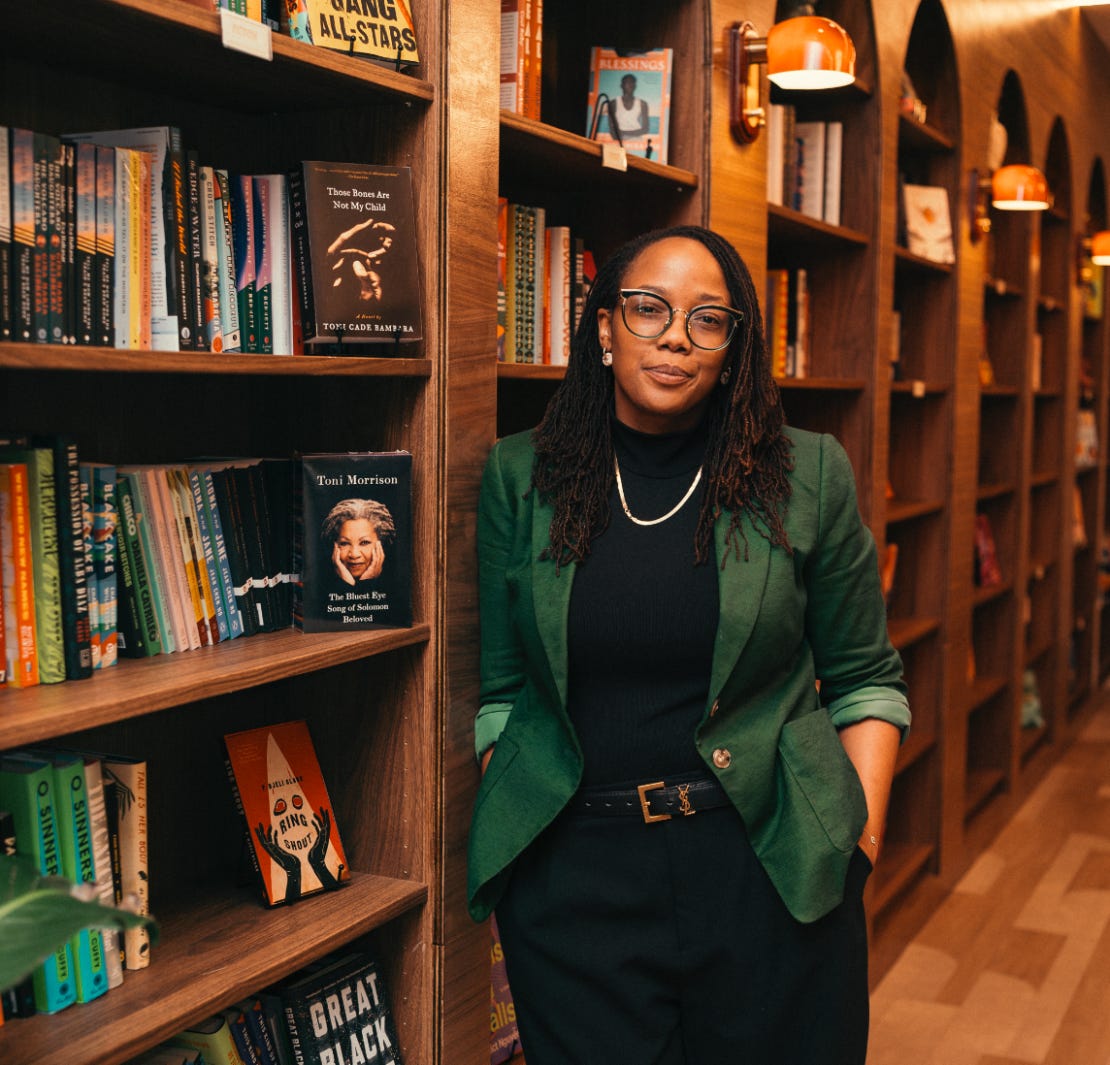
The following conversation has been edited and condensed.
What did it take to go from the idea of creating something to actually opening Gladys?
Originally, I wanted to open a spa, which was informed by my own experiences with burnout. We’re overworked as Black women, but the wellness space is so white. I had this dream of a space that centered Black women, that centered their rest, that felt like an uplift for us in a world that is often trying to kill us. I decided to do the spa after I got laid off in the fall of 2024, but I started getting really worried about the economic outlook and thinking that it’s going to be tough because it’s the first thing that people remove from their budget.
The bookstore idea came about because I felt like I was aging out of the queer social scene in New York. I’m only 37, but I feel like I’m 85 when I go out, and I love to host. Gladys came about really from a desire to do something that centered black women, my desire to do something that was specifically around Black lesbians, and my love of books.
What does it mean to have a space that centers black women, but particularly Black lesbians?
Lesbian erasure is real. I identify as queer as well, but I’m sensitive to lesbian erasure because in a patriarchal society, to be a woman who loves women is radical. Sometimes people feel like you can’t be both Black and queer. That if you are queer, you’re de-raced, and if you’re Black, you are desexualized. When we have these Black icons who are also queer [Lorraine Hansberry, Audre Lorde, Nikki Giovanni], the erasure of their lesbian or queer identity is kind of incentivized because of latent homophobia that’s not specific to Black people, but in our society as a whole.
In addition to the erasure of the store’s audience, what were some of the other barriers that you faced while opening a small business as a Black woman?
I think we’re in a dangerous moment where the reality of Black life is so talked about, but so disregarded that people take it for granted. When you talk about the structural barriers to access to capital, people go, “yeah, I read a New York Times article about that.” I struggle with this personally because I think intellectualization is actually an emotional bypassing.
What does it mean for a people to have once been enslaved and then have a century of being locked out of most formal capital structures?
For me, those structural barriers are, first of all, access to capital. My family of origin, we were poor but I want to be super clear, relatively speaking, I’m incredibly privileged. I have assets, I have two Ivy League degrees - and even then, it was hard.
I knew that to get the small business loan that made this place possible, they required me to have a job, and it couldn’t be any job; I needed to make a certain level of six figures. At first, I was like, why? Now I get it, because it’s been hard even with the income from my job. Luckily, I do the type of work where that is possible, but I think about folks who have a great vision, don’t have access to capital, and that kind of capital requirement for a loan precludes them.
There’s this other part of entrepreneurship we like to tout, like, “I had nothing.” When you dig deeper into that, people have something. It’s too neat a narrative to really make sense. Sometimes it’s access to friends and family or working, like in my case. I don’t come from generational wealth, and I think a lot of my early career was characterized by a drive to never experience the kind of poverty that I grew up in. People have a real romanticized, literature-infused view of poverty, but when you’ve experienced it, you’re like, I don’t care what I have to do, but I’m not going back there, you know? I have a belief that over time, Gladys is going to get to a better spot, but I am kind of closer to poverty than I was before.
I think the other one that we don’t talk enough about is that I don’t have a partner. Given the level of singleness amongst black women, I don’t think people appreciate that that’s not just an emotional need. There are real financial implications to being unpartnered, in general, but especially right now when the cost of living is much higher. I’ve been very blessed with amazing friends, but I think the emotional toll of it. I don’t think we talk enough about how, as Black women, we’re often the people giving support, but often we lack that level of support for ourselves.
 Tiktok failed to load.
Enable 3rd party cookies or use another browser
What role has your community played in helping you open Gladys?
My community has played a role in three different ways. The first two are emotional and spiritual. This is so hard. The way my community has listened, encouraged, and in the dark moments, reminded me that I’m capable - I can’t overstate that enough.
People also just showed up and volunteered, like opening books - I think I probably had more than a thousand books in the store when we opened. One friend project-managed the grand opening because there were so many different pieces to it, and she’s a great organizer.
The most powerful part is that my best friend loaned me $40,000. We were really short because the loan was taking a long time, and there were capital expenses that were coming due. I was really stressed. He was like, “I believe in you. I believe in this dream.” And he is neither Black nor a woman. I think that meant a lot to me because he also doesn’t come from means. He works in public health - he’s not a tech executive - and that’s a substantial amount of money for him. It was a real investment in this little dream that I had.
During the middle of our conversation, a young man came in to ask if he could use the space for an event that was rescheduled due to the blizzard in New York. Black bookstores have a long history of serving as spaces that both educate and empower the community. What are other ways Gladys carries on that tradition?
Char Adams talks about in her book, Black-Owned, that before publishing cared about Black books, and that it was Black bookstores that gave them a chance. Gladys is now getting our consignment program up. Not everybody can get published by a Big Five publishing house. If you self-publish, which is easier now than it’s ever been, you should be able to go to your local bookstore. We can’t afford to carry the cost of that inventory, but the way consignment works is that we pay you once you have a sale. For us, that’s a win-win where we get to expose people to work that could be the next Octavia Butler or Terry McMillan.
It was also very important to me that it be in Bed-Stuy. As a person who is a homeowner in the community, I’ve seen the neighborhood change, even in my short time of living here. I had no idea the kind of community I was kind of buying into, but two things became clear: how special this place is and how under threat it is to change, especially, I think, hastened by the pandemic. As folks got priced out of Park Slope and Williamsburg and Bushwick, Bed-Stuy became this kind of place, like, “oh, we can own there.”
I fundamentally believe that you learn about the history, the present, and the future of a place from the businesses. Having a space that is unapologetically Black and unapologetically queer is important to me. To be able to offer a space to gather for people who have dreams who need a space and a platform for those dreams to come alive - that means something to me.
I wanted the space to be beautiful because I think we deserve access to beauty. We do a lot of literary-based events, obviously as a bookstore, but especially because I think the work deserves that level of regard. That’s the part I take the most seriously. I view writers as celebrities - taking words and making a world or taking complex ideas and making them accessible to people, that’s important, but I think especially in a world that gaslights Black people, that we have no culture. We’ve always had culture.
Events are also important to me. I worked at Instagram. I promise you what you’re doing behind that keyboard is not the same as me looking into your eyes, sitting with and listening to your work, your ideas, and having to do it in real time, not face you as a set of letters on a screen, but Kayla as a person. That’s why Black people were not allowed to congregate because there’s power in us coming together.
The store’s named after your grandmother. I know there are several other Black-owned Brooklyn bookstores - Liz’s Book Bar and BEM - that are also named after their grandmothers. Why do you think that is?
I view grandparents as living ancestors - they have and always have had a special place for us as Black people and especially for African-Americans. I don’t think we understand what it means to be a people where our families were totally disrupted, either by the reality of slavery or life outcomes. I think our matriarchs in particular have always been culture bearers, and I think grandmothers hold a special place amongst Black people because they have been culture bearers. When you see people who want to do this to honor their grandmother, it’s about the larger project of a bookstore, which is cultural veneration via ancestral veneration.
The other part is really around this idea that people feel lost right now. We’re seeing a resurgence in nostalgia. Some of that is escapism, that the present feels hard and so we’re escaping back into better times. I think some of that is actually us trying to harken for ancestral wisdom at a time when we need it most. I deeply believe in the concept of Sankofa, that you have to look back to move forward. When we look back, the ancestral wisdom of our grandparents is a light. Before we had these fancy labels called mutual aid, it was like, let me go talk to my neighbor and see if I can borrow this until I get my check, and then they borrow from me. The ways that we’re looking to survive now are literally things that our ancestors had to do.
What’s next for Gladys?
I think we live in a world of mimetic politicization, where people’s politics are informed sometimes by memes, but not engaging with, like, what’s the reality of this? Let’s actually get to it in terms of dollars and cents, because I want to operate in a way that reflects my values, and I think the most important thing I can do right now is to keep this business open in a way that is fair and sustainable.
I want to get the business to a place where we are on a profitable, sustainable trajectory. There are a lot of beloved black businesses that will be open one day and closed the next. I used to be like, how did that happen? And now I get it. People were flushing paper towels down the toilet, and we had to spend $3,000 on a plumber to snake it. That’s why you don’t see paper towels in our bathroom anymore. We have hand towels that I wash at my house because it’s not worth it. I don’t know if we could survive another $3,000 hit.
Rapid fire. What was the last book you read?
Model Home by River Solomon. It is the darkest book I’ve read in quite some time. The premise is that there’s a haunted home in the Dallas suburbs that a Black family occupies. The children all leave to escape the haunted home, but then their parents die, and they have to come back and contend with what it means to grow up there. I think it’s this larger allegory for the things that we do as Black people for proximity to privilege, for saving face, the violence of being the only Black person in a white space - that alone is a haunting.
Favorite Black literary icons?
A contemporary author I’m enjoying is Courtney Faye Taylor, and a book of poems called Concentrate. It’s about Latasha Harlins, who was a Black girl who was killed at the hands of Korean shop owners and whose death was a precursor to the LA riots. There are so many forgotten young Black girls, and her story is an allegory for all the types of things that Black girls contend with. She was being abused by a safe adult in her life who was at a community program she was in, and nobody cared except her aunt. She had dreams, and she was a poet. Concentrate is a mixed media book that brings in a lot of elements of the archive.
On the literary front: Toni Morrison was just so unequivocal that we have a culture as black people, that culture is rich, it deserves, and can be engaged with in a way that is true literary fiction that does not live under the gaze of white people.
Finally, poetry-wise: Gwendolyn Brooks, because she was a genius. The fact that she spent her life teaching black students at a historically Black university in Chicago - I think people take Black women’s genius for granted. After winning the Pulitzer, she could have done so much. To have that highest literary award and then to say, I want to use my genius to uplift Black people, I think she’s engaging in that project, which is really near and dear to my heart, too.
You can support Gladys by visiting their store at 306 Malcolm X Boulevard or buying from their Bookshop. Follow along on Instagram + TikTok.
If you liked this interview, be sure to check out last month’s with Jenn Burchette and consider subscribing to see who I speak with in March for the next “Going for It.”

The series offers a window into the policymakers, activists, creatives, and entrepreneurs from around the country who aren’t waiting for anyone’s permission to go after something they’re passionate about - and neither should you!
Gladys is one of my favorite bookstores. ty for your care and effort in putting this together!!